

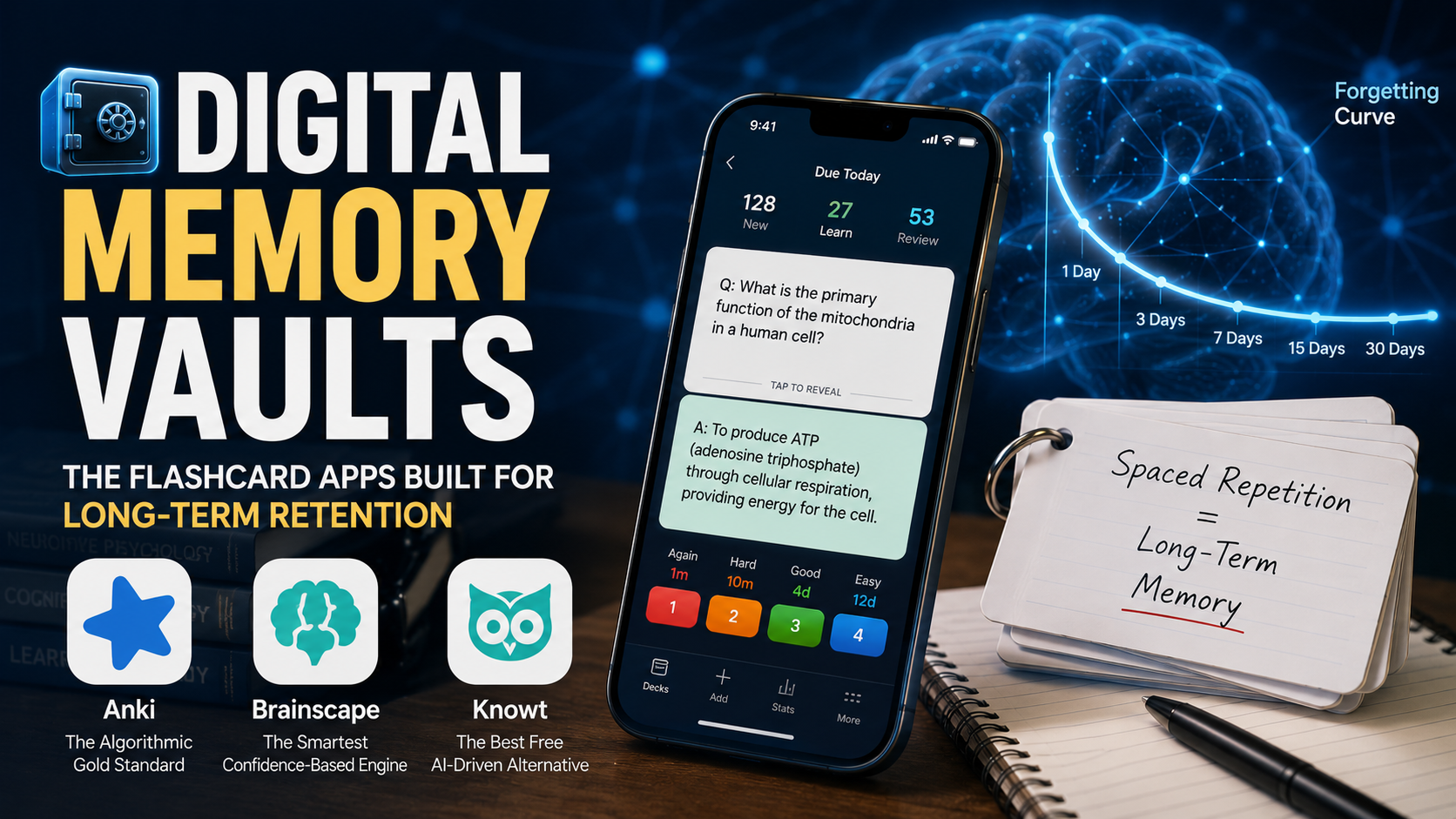
The human brain is a leaky bucket. Psychologists have long understood the "forgetting curve"—the rapid rate at which new information evaporates from our memory if it isn't actively reinforced. For professionals mastering complex certifications, medical students memorizing thousands of anatomical structures, or language learners building fluency, traditional rote memorization is an exercise in futility. The only proven antidote to the forgetting curve is Spaced Repetition (SRS), a technique where information is reviewed at precisely expanding intervals just as you are on the verge of forgetting it.
While physical flashcards have existed for centuries, their digital counterparts have evolved into sophisticated, algorithmic engines designed to cement information into your long-term memory vault.
To determine which platforms actually deliver on their promises, I spent weeks putting the most popular flashcard apps through rigorous real-world testing. I evaluated them based on three non-negotiable criteria: algorithmic efficiency, the friction of card creation, and long-term usability. I didn't just look at the feature lists; I tested how these apps handle complex subjects, how they sync across devices during a hectic workday, and whether their user interfaces assist or hinder the learning process.
The following applications represent the absolute best tools available on the US market in 2026 for achieving genuine, long-term information retention.
Availability: iOS, Android, Desktop, Web
Pricing Model: Free for Android, Desktop, and Web; one-time $24.99 fee for iOS
Anki is widely recognized as the benchmark against which all other SRS apps are measured. During my testing, its core engine—the SM-2 algorithm (with newer iterations like FSRS now widely supported)—consistently yielded the highest retention rates. Anki does not coddle the user. It is a dense, deeply configurable tool that prioritizes substance over style. When I used it to drill highly technical concepts, the software's ability to optimize review intervals was flawless. It forced me to confront my weakest cards frequently while pushing well-memorized concepts weeks into the future, completely eliminating wasted study time.
Pros: Unrivaled scientific credibility and algorithmic maturity. It is completely free on most platforms, and its open-source nature means it will never lock your data behind a corporate paywall.
Cons: The user interface feels dated and unintuitive, presenting a steep learning curve that often requires watching external tutorials to master. Furthermore, it lacks native AI card-generation tools, making the manual creation process slow.
Availability: iOS, Android, Web
Pricing Model: Free basic version; Premium subscription tiers start at approximately $20 per month
Brainscape takes a slightly different approach by utilizing Confidence-Based Repetition (CBR). Instead of a binary "correct" or "incorrect" choice, after flipping each card, you rate how well you knew the answer on a scale of 1 to 5. When I tested this during a high-volume study session, I found this granular feedback loop incredibly effective. It allows the algorithm to tailor the next interval much more precisely to your exact cognitive state. If you rate a card a '1' (total guess), it will reappear almost immediately. If you rate it a '5' (perfect recall), it is pushed far back. It effectively bridges the gap between passive recognition and active mastery.
Pros: The interface is exceptionally clean and intuitive, requiring zero setup time. Its marketplace features high-quality, expert-curated decks created by professors and industry professionals, which are far superior to typical crowdsourced content.
Cons: The premium subscription model is relatively expensive compared to competitors, and the free tier is heavily feature-gated.
Availability: iOS, Android, Web
Pricing Model: Generous free tier; Ultra subscription available for advanced features
Knowt surged in popularity as a direct response to other platforms paywalling their essential features, and after testing it, the appeal is clear. Its standout capability is its AI-assisted card generation. During my evaluation, I uploaded a dense PDF document and a link to a lecture video; within seconds, Knowt parsed the material and generated a highly accurate deck of flashcards. For a busy professional, this eliminates the single biggest barrier to entry for spaced repetition: the time-consuming labor of creating the cards themselves.
Pros: The free tier is remarkably generous, offering unlimited AI flashcard generation from various media formats. It also allows for seamless importing of existing sets from other platforms like Quizlet.
Cons: Its spaced repetition algorithm is less transparent and lacks the deep configurability found in FSRS-based tools like Anki.

Selecting the right flashcard app depends entirely on whether your priority is total control or total convenience.
If you are a student or professional who demands the absolute highest retention efficiency and wants a tool that will remain stable for decades, Anki remains the undisputed king. Despite its unpolished exterior, its engine is the most scientifically sound framework for long-term memorization.
However, if you find the prospect of manually typing out thousands of cards daunting, Knowt is the most practical choice for the modern era. Its ability to instantly transmute PDFs and videos into structured, algorithmic study sets removes the friction that causes most people to abandon spaced repetition before they see results.