
When severe weather hits, broad regional forecasts often fall short. A county-wide alert does little good when flash flooding is affecting one neighborhood or a fast-moving storm is targeting a single street. In 2026, effective weather preparedness depends on fast, hyper-local alerts delivered directly to a phone or smartwatch.
To identify the most reliable options, a range of popular weather apps were evaluated across several criteria, including alert speed, radar quality, location precision, and real-time warning reliability during rapidly changing weather conditions.
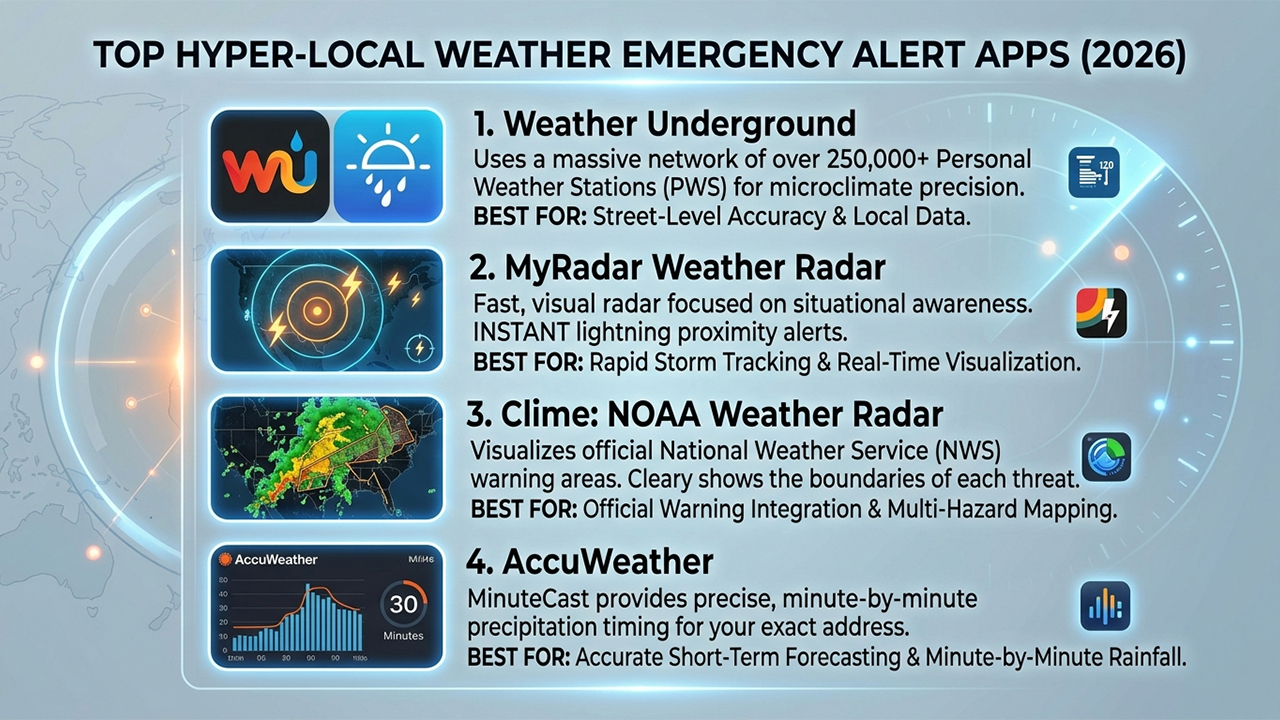
Particular attention was paid to notification latency, neighborhood-level accuracy, and the clarity of emergency information during high-risk events. After extensive testing, these four apps stood out as the strongest choices for homeowners and families who want faster, more localized weather alerts.
Pricing: Free (with ads) / Premium subscription available
Weather Underground differentiates itself through its massive network of personal weather stations (PWS). Instead of relying solely on airport-based reporting stations, the app pulls data from nearby community-installed sensors, offering far more localized conditions in many areas.
In testing, this approach proved especially useful in neighborhoods with unique microclimates, such as coastal regions, hilly suburbs, or dense urban districts. Rainfall totals, wind gusts, temperature changes, and pressure readings often updated faster and with more precision than broader forecast platforms.
For homeowners who want street-level weather awareness rather than city-wide averages, Weather Underground remains one of the strongest options available.
Extremely detailed hyper-local weather data
Excellent support for neighborhood weather stations
Flexible and customizable dashboard
Ads in the free version can feel intrusive
Emergency alerts are less aggressive than dedicated warning apps
Pricing: Free with optional premium upgrades
MyRadar focuses heavily on speed and visual clarity. Instead of burying users in menus or long forecast summaries, it immediately opens to a live radar map that updates quickly and smoothly.
During testing with active thunderstorms, the app’s lightning-alert system was particularly impressive. Push notifications arrived almost instantly when lightning strikes occurred within a selected radius, making it especially useful for sudden summer storms and rapidly developing severe weather.
Its radar performance also stood out during fast-moving storm events, where quick visual updates mattered more than lengthy forecast explanations.
Fast, responsive radar visualization
Excellent lightning proximity alerts
Clean interface that prioritizes urgent information
Some advanced radar layers require separate purchases
Forecast detail is lighter than some competitors
Pricing: Free basic version / Premium subscription available
Clime excels at visualizing official government weather alerts. The app overlays National Weather Service warning polygons directly onto its radar maps, making it easier to see whether a specific property falls inside or outside an active warning area.
This proved particularly valuable during overlapping hazards such as flash floods, wildfire smoke events, winter storms, and severe wind alerts. Rather than displaying vague regional warnings, Clime clearly shows the geographic boundaries of each threat.
For users who prioritize official warning data and detailed hazard mapping, Clime offers one of the best interfaces currently available.
Strong integration with official weather warnings
Excellent multi-hazard visualization
Clear and easy-to-read radar layers
Premium pricing is relatively high
Several useful features are locked behind subscriptions
Available on: iOS, Android, Apple Watch
Pricing: Free with optional Premium plans
AccuWeather’s biggest advantage is its MinuteCast system, which provides minute-by-minute precipitation forecasts for highly specific locations.
Instead of offering only broad hourly rain probabilities, the app estimates exactly when rain or snow will begin and end at a precise address. In testing, precipitation timing was frequently accurate within just a few minutes during localized storms.
This level of precision can be genuinely useful for homeowners trying to protect outdoor equipment, secure patio furniture, or prepare for short but intense downpours.
Highly accurate short-term precipitation forecasts
Strong smartwatch support
Fast severe-weather notifications
Interface can feel crowded
Promotional content occasionally distracts from key information
Each of these apps serves a slightly different purpose, and the best choice depends on the type of weather risks a household faces most often.
For the fastest visual storm tracking and immediate situational awareness, MyRadar stands out as the strongest overall option. Its responsive radar system and lightning alerts make it especially effective during rapidly developing storms.
Meanwhile, Weather Underground remains one of the best tools for localized environmental monitoring thanks to its community-driven weather station network.
For the most complete setup, combining MyRadar’s rapid radar updates with Weather Underground’s neighborhood-level weather data creates a particularly effective home weather-alert system. Together, they provide both fast emergency awareness and highly localized conditions that broader forecasting apps can sometimes miss.