

Trying to learn a language while crawling through traffic or squeezing onto a packed train? That's where a lot of language apps fall apart. Tap this. Match that. Stare at flashcards. Great on the couch. Not so great when your hands are occupied and your eyes have somewhere more important to be.
For commuters, the rules change completely.
A genuinely useful language app should disappear into the background. No swiping. No reading tiny prompts. No hunting for the right button at a stoplight. The best ones turn your drive or train ride into an audio workout—listen, think, respond, repeat. You're not memorizing words off a screen; you're training your brain to react in real time.
We spent time with the top options on iOS and Android and looked at three things that actually matter during a commute: true hands-free usability, active recall that keeps your brain working, and how well the experience plays with Bluetooth, car systems, and audio controls.
Here are the standouts.
Pimsleur has been around forever, and there's a reason it refuses to disappear. It still does one thing remarkably well: it forces you to speak.
The magic sits inside its Graduated Interval Recall system, created by Dr. Paul Pimsleur. Lessons feel less like lectures and more like verbal sparring sessions. You'll hear a conversation between native speakers, pick apart the structure, and then—without warning—the app throws the ball back at you:
"How do you say: 'No, I want to eat later'?"
Then silence.
About five seconds of it.
Just enough time to make you scramble mentally before the answer arrives. That pressure matters. Real conversations don't wait politely while you search through vocabulary flashcards in your head.
·Pro: Works beautifully with Apple CarPlay and Android Auto, so you can navigate lessons safely from dashboard controls.
·Pro: Huge language selection—more than 50 options, including regional variations and less common choices.
Con: The subscription price lands on the expensive side.
Con: Some conversations can feel a little polished and formal, as though they're preparing you for a business trip rather than a night market or neighborhood café.
Language Transfer feels like one of those hidden recommendations you hear from a friend and immediately wonder why more people aren't talking about it.
Created by educator Mihalis Eleftheriou, it takes a completely different route. Instead of drilling vocabulary into your skull, it teaches you how the language works. Think of it as learning the framework rather than memorizing bricks.
You listen to recordings of real teaching sessions where an instructor guides a student through the language step by step. Suddenly you start spotting patterns. Words stop feeling random. Pieces begin clicking together.
It's oddly satisfying. Like solving puzzles while driving.
Pro: No ads. No subscriptions. No premium traps. Just lessons.
Pro: Entire courses can be downloaded and played with your screen off, making it ideal for commuting.
Con: Language selection remains fairly small.
Con: No speech recognition or automated correction; you're judging yourself against the recordings.
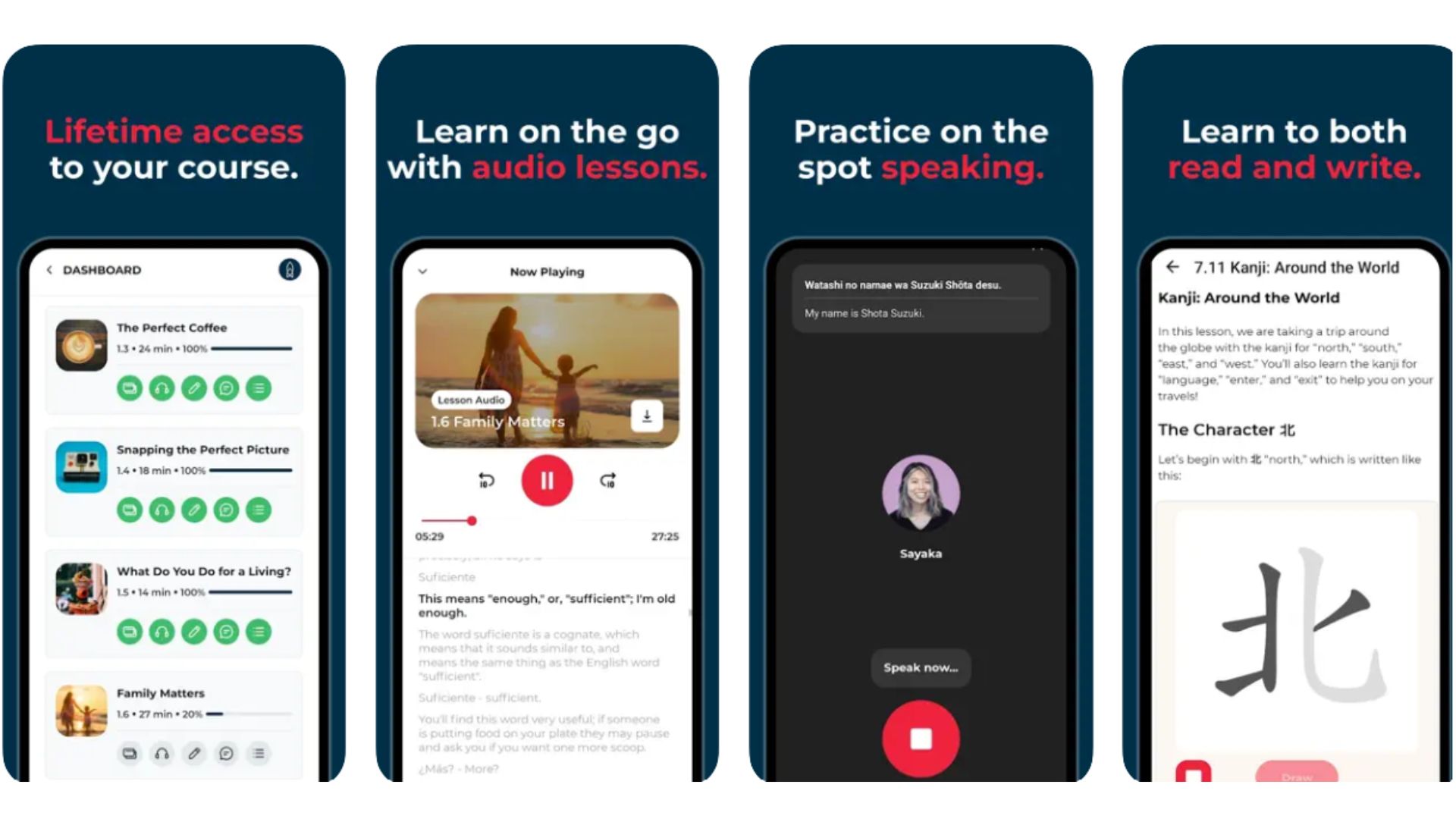
Michel Thomas built his teaching philosophy around one unusual idea: learning should feel relaxed.
No pressure. No frantic note-taking. No "memorize these 50 words before tomorrow."
Instead, you sit in on a recorded classroom with two beginners. You hear them hesitate, stumble over pronunciation, get things wrong, then work through it. Strangely enough, hearing someone else struggle takes the edge off your own anxiety.
You stop worrying about mistakes because mistakes become part of the lesson.
And for people who freeze up when speaking another language? That's huge.
Pro:
· Excellent at helping nervous learners get comfortable speaking out loud.
· Breaks grammar into practical building blocks rather than textbook rules.
Con:
· Buying complete course libraries gets expensive quickly.
· Some recordings sound noticeably dated compared with modern audio productions.
Mango often gets attention for its polished visual design, but commuters should care about one specific feature: Hands-Free Mode.
Switch it on and the app fades into the background. Lessons become a continuous audio flow: native speech, cultural notes, pauses for response, then repetition.
No reaching for your phone. No peeking at the screen.
Just press play and drive.
· Pro: Many public libraries offer free access, which makes it one of the best deals around.
· Many public libraries offer free access, which makes it one of the best deals around.
· Explains how phrases map structurally between languages, making sentence patterns easier to understand.
Con:
· The audio sessions can feel more rhythmic than conversational.
· Vocabulary occasionally lingers too long on beginner material.
For commuters, Pimsleur still sits at the top of the list.
Language Transfer deserves serious attention too—especially if you're on a budget—but Pimsleur edges ahead because it understands one thing many language apps miss: passive listening isn't enough.
You can let a podcast wash over you and feel productive. You can spend thirty minutes hearing Spanish, Japanese, or Italian in the background.
But hearing isn't speaking.
Pimsleur constantly interrupts your autopilot. It asks questions. Makes you answer. Gives you just enough silence to feel slightly uncomfortable before pushing you to respond.
And that matters. Because when you're eventually standing in a real conversation, there won't be a pause button there either.