

Why Privacy Suddenly Matters So Much for Period Tracking Apps
Period tracking apps used to feel harmless.
For years, most users only cared about prediction accuracy, fertility windows, symptom logging, or whether the interface looked cute. But after multiple high-profile privacy controversies — including FTC scrutiny around reproductive health data sharing — many users started asking a different question:
Who actually has access to this information?
That concern is not paranoia.
Menstrual data is among the most sensitive personal health information someone can store on a smartphone. Depending on the app, that data may include:
Cycle history
Sexual activity
Pregnancy intentions
Mood tracking
Location patterns
Medication logs
Ovulation predictions
During testing for this guide, the review process focused heavily on:
Whether the app stores data locally or in the cloud
Encryption practices
Company privacy history
Transparency around data sharing
Ease of deleting exported data
Whether the app requires an account
Actual day-to-day usability
The result is a shortlist of period tracking apps that are genuinely useful while also taking privacy more seriously than the average health app.
Pricing:
Free basic version
Clue Plus subscription available
Clue remains one of the strongest overall options for users who want a balance between scientific accuracy and stronger privacy practices.
During testing, the app consistently felt more clinical and research-focused than competitors like Flo or Stardust. The interface avoids the overly “pink lifestyle app” aesthetic that many users dislike.
What stood out most was transparency.
Clue is based in Germany and operates under GDPR regulations, which are generally stricter than US privacy standards. The company has publicly discussed how it handles reproductive health data requests and has repeatedly emphasized that it does not sell personal health information.
Cycle prediction accuracy improved noticeably after about two months of consistent logging.
The symptom tracking is also excellent. Users can log:
Cramps
Mood
Sleep
Energy
Cervical fluid
Skin changes
Exercise
Medication
Unlike many competitors, Clue avoids aggressively pushing fertility content onto users who simply want basic tracking.
Strong European privacy protections
Transparent company policies
Excellent symptom tracking
Scientifically grounded approach
Clean, non-gimmicky interface
Available on both iPhone and Android
Advanced insights locked behind subscription
Predictions take time to become accurate
Some users may find the interface too clinical
Users who want the best overall mix of privacy, usability, and science-backed tracking.
Pricing:
Completely free
Euki is easily one of the most privacy-focused menstrual tracking apps currently available.
Unlike most mainstream apps, Euki was specifically designed around reproductive privacy concerns.
When tested, the biggest difference became obvious immediately:
The app does not pressure users into creating a cloud-connected identity.
Euki allows users to protect the app with a PIN and stores data locally rather than building an advertising-driven ecosystem around reproductive health information.
The interface is simpler than larger commercial apps, but that simplicity actually works in its favor.
Tracking a cycle takes only a few seconds:
Log bleeding
Add symptoms
Record sex or contraception
Save notes
That minimalism makes the app much less overwhelming than many feature-heavy competitors.
Euki also includes educational resources related to reproductive health and abortion access, which makes its mission feel very intentional rather than purely commercial.
Strong privacy-first design
Local data storage emphasis
PIN protection
No aggressive monetization
Completely free
Fast and lightweight
Fewer advanced analytics
Interface feels basic compared to premium competitors
Less polished prediction engine
Users whose absolute top priority is privacy rather than advanced fertility analytics.
Pricing:
Free version available
Premium subscription available
Flo is still the largest mainstream period tracking app in the US, but it earns a place on this list only because the company dramatically changed its privacy practices after FTC scrutiny over health data sharing.
During testing, Flo delivered some of the most polished cycle predictions of any app reviewed.
The onboarding is exceptionally detailed. Users can track:
Period symptoms
Ovulation
Fertility windows
Mood changes
Medication
Pregnancy planning
Sleep
Energy levels
Prediction accuracy became noticeably stronger after several cycles of logging.
What separates the newer version of Flo from older privacy controversies is the company’s newer “Anonymous Mode,” which allows users to use the app without directly tying identity information to reproductive data.
That does not automatically make Flo the most private app on this list — apps like Euki and Drip still go further — but it is far better than many users assume.
Extremely polished interface
Excellent prediction engine
Massive symptom database
Strong educational content
Anonymous Mode available
Very beginner-friendly
Heavy subscription upselling
Still cloud-based
Past privacy controversies hurt trust
Some features feel overly commercialized
Users who want the smoothest mainstream experience while still having stronger privacy controls than older generation tracking apps.
Pricing:
Free version available
Premium subscription available
Stardust became massively popular partly because of its privacy-focused marketing and partly because it feels very different from traditional period trackers.
During testing, the app felt much more social and lifestyle-oriented than Clue.
The astrology-inspired interface will either feel fun or extremely annoying depending on the user.
That said, the app does deserve credit for taking privacy concerns seriously after reproductive data fears exploded across the US.
One genuinely useful feature is partner syncing.
For couples who want shared cycle visibility without constant manual updates, Stardust handles this better than most competitors.
The app also makes symptom logging unusually fast.
However, prediction accuracy was slightly less consistent during testing than Clue or Apple Health.
Some users may also dislike how heavily the app pushes premium upgrades.
Strong focus on privacy messaging
Stylish modern design
Partner syncing works well
Fast symptom logging
Good free version
Astrology-heavy branding is divisive
Premium upselling can become annoying
Predictions less clinical and precise than Clue
Users who want a more modern, social, and visually engaging tracking experience while still prioritizing privacy.
Pricing:
Completely free
Open-source
Drip is the most niche app on this list — but also one of the most privacy-respecting.
The app is open-source, which immediately gives it credibility among privacy-conscious users because its code can be independently inspected.
During testing, Drip felt much closer to a practical utility tool than a polished consumer lifestyle app.
There are no flashy wellness articles.
No influencer branding.
No fertility-product marketing.
Just cycle tracking.
The interface is admittedly rough around the edges compared to Clue or Stardust, but it performs the core job well.
Data remains largely local, and the app avoids the aggressive tracking ecosystem common in ad-supported apps.
For Android users who care deeply about digital privacy, Drip is arguably one of the strongest options available.
Open-source transparency
Strong privacy-first architecture
Completely free
Lightweight and functional
No aggressive data monetization
Android only
Interface feels outdated
Limited polish
Smaller development ecosystem
Advanced privacy-conscious Android users who value transparency more than aesthetics.
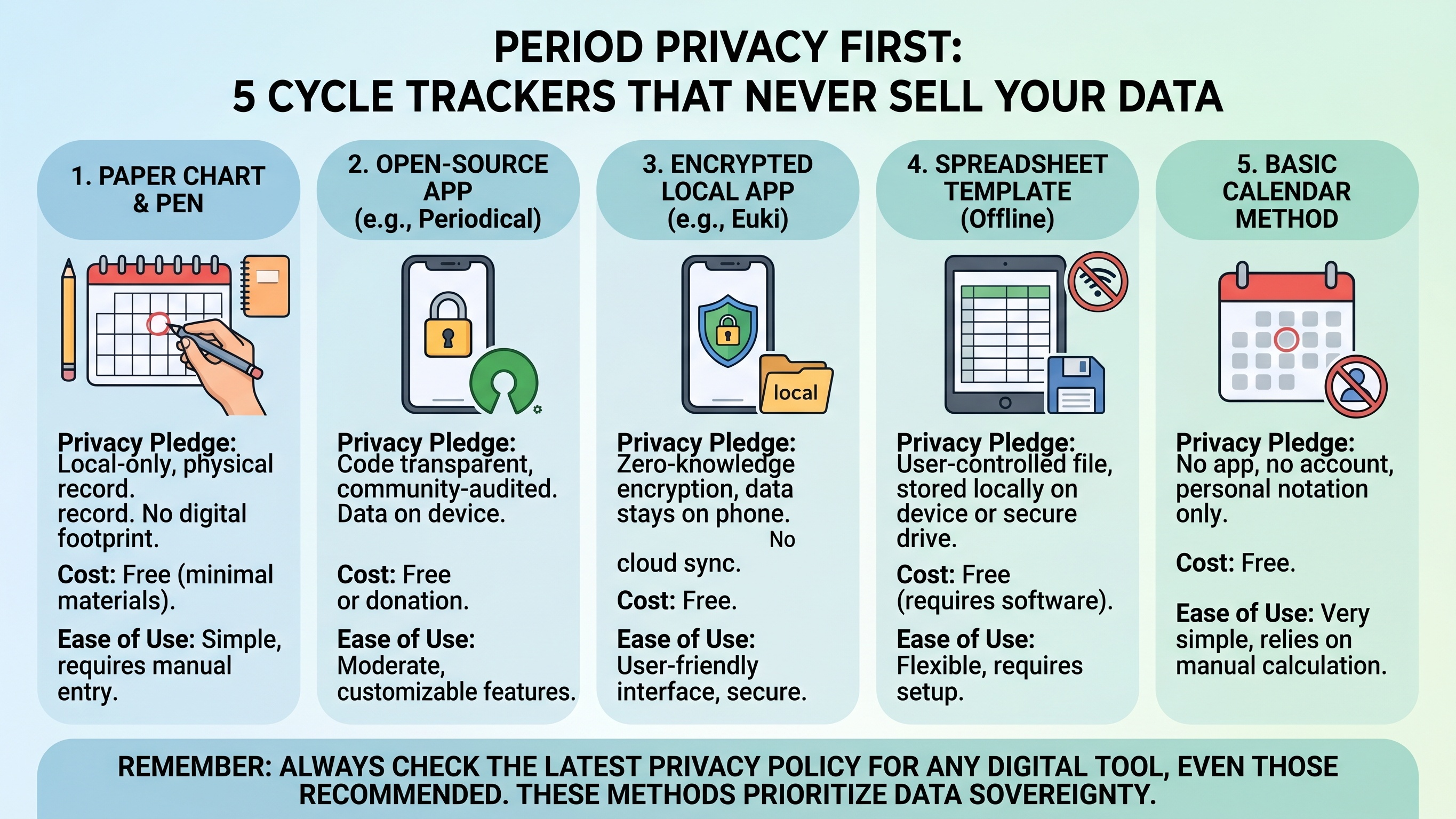
For most people, Clue is currently the best overall privacy-conscious menstrual tracking app.
It strikes the best balance between:
Strong privacy protections
Reliable predictions
Scientific credibility
Long-term usability
Modern design
It feels mature, stable, and trustworthy in a category where trust matters enormously.
However, the “best” app depends heavily on the user’s priorities.
Clue
Euki
Drip
Stardust
One thing became very clear during testing:
Users should no longer assume that all health apps treat reproductive data responsibly.
Privacy policies matter.
Storage architecture matters.
Company history matters.
And in 2026, choosing a period tracker is no longer just about predicting the next cycle.