

Standing in the aisle of a major brick-and-mortar retailer—looking at a product they want—while wondering whether the store down the street is selling it for 20% less is a frustratingly common retail experience. Big-box stores often rely on convenience, betting that once a shopper is already physically in the building, they’ll pay the sticker price rather than drive across town.
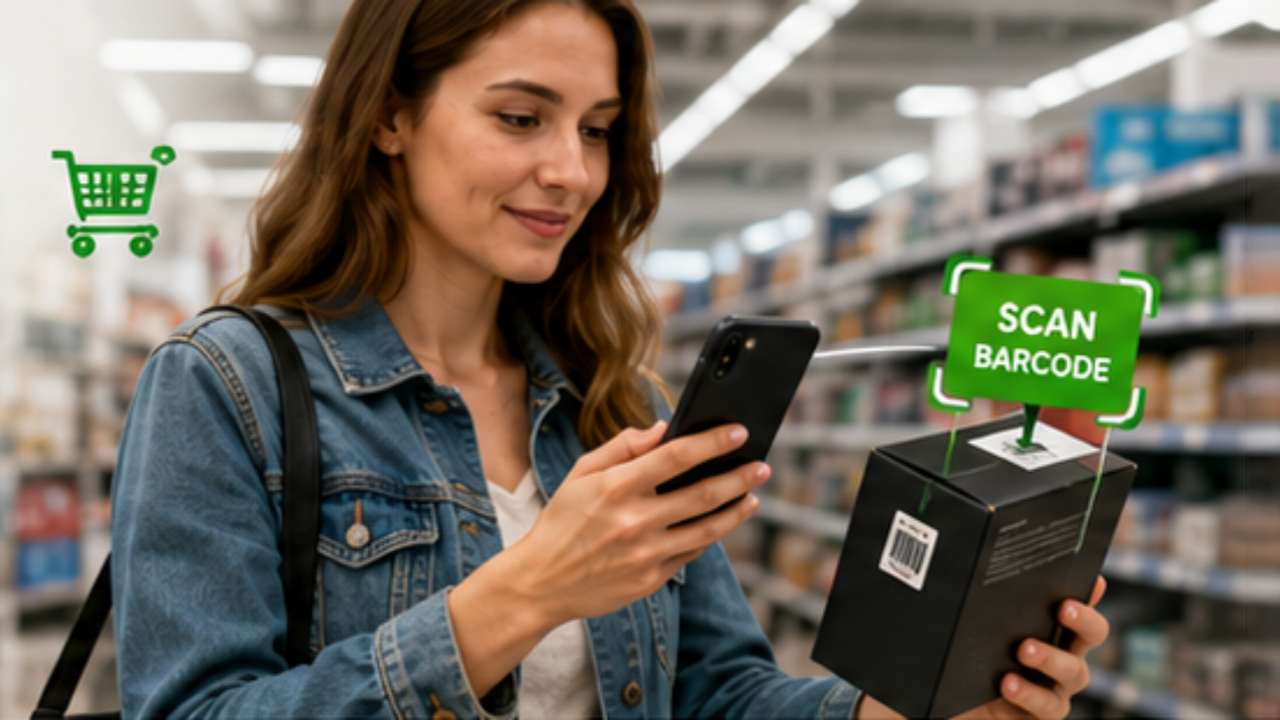
When the latest retail tracking tools were put to the test in real-world shopping environments, the goal was to determine which apps truly deliver on the promise of instant transparency. The focus wasn’t on generic online price checkers that simply redirect users to e-commerce warehouses. Instead, the evaluation centered on platforms that could identify local inventory, map nearby brick-and-mortar alternatives, and surface price discrepancies directly at the shelf.
After scanning dozens of consumer electronics, household essentials, and groceries across multiple shopping corridors, the tools were compared on scanner speed, local database accuracy, price-matching support, and overall user experience. From that review, the following applications emerged as the most dependable digital options for reducing brick-and-mortar checkout costs.
Availability: App Store and Google Play
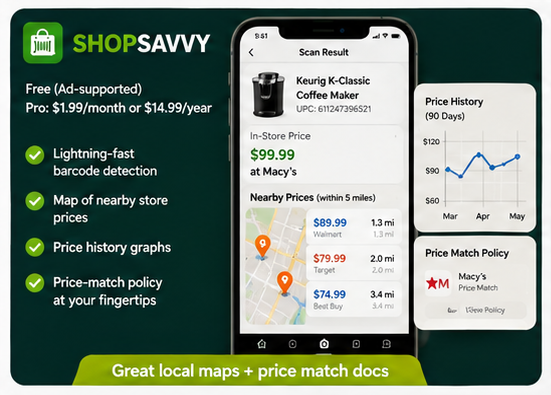
Pricing: Free (Ad-supported) / Pro Subscription at $1.99/month or $14.99/year
ShopSavvy remains one of the oldest and most aggressively updated barcode scanners on the market. During our field testing, the platform proved that it has successfully transitioned into the modern era by using machine-learning-assisted camera modules that lock onto 1D and 2D barcodes almost instantly.
The Reality Check
The core feature that genuinely works in the aisles is the app's omnichannel breakdown combined with physical store mapping. When we scanned a brand-name coffee maker at a national department store, ShopSavvy didn't just throw back a list of web links; it populated a localized map showing the exact price of that same item at three separate retail centers within a five-mile radius. Additionally, its integrated price-matching tool pulls up the store’s official internal policy pages, giving you the exact documentation needed to demand a lower price directly at the cash register.
Pros & Cons
* Pros: Lightning-fast barcode detection powered by machine learning; highly reliable map thumbnails for nearby store results; comprehensive independent price history graphs that tell you if a local "sale" is actually a good deal.
* Cons: The free version is heavily saturated with intrusive banner ads; historical price trends occasionally take a few seconds to populate on slower cellular networks.
Availability: App Store and Google Play (as "Price Scanner" on Google Play)
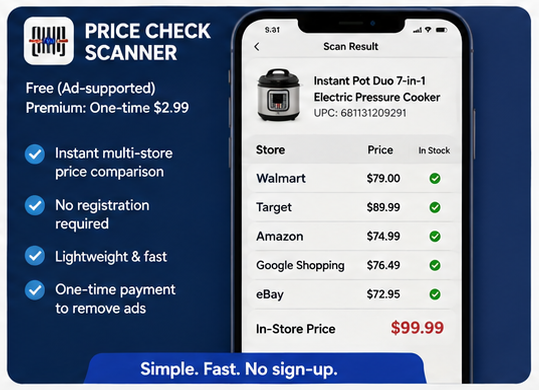
Pricing: Free (Ad-supported) / One-time $2.99 Premium upgrade to remove ads
Developed by Qvyshift, Price Check Scanner is built for the minimalist consumer who wants zero fluff. It completely skips the social features, coupon aggregators, and account registrations that slow down alternative shopping apps, focusing strictly on raw utility.
The Reality Check
The standalone feature that operates flawlessly is its instant multi-tab grid comparison. The moment a UPC code is recognized by your device's camera, the app immediately generates a clean matrix comparing the in-store price against local and digital standard-bearers like Walmart, Target, Amazon, Google Shopping, and eBay. For items that qualify for local pickup from those competing chains, you can spot the price gap in seconds without having to navigate through nested menus.
Pros & Cons
* Pros: Requires absolutely no registration, login, or personal profile tracking to function; highly lightweight app architecture that performs exceptionally well in poor retail cell zones; very affordable one-time payment option to go completely ad-free.
* Cons: The user interface looks utilitarian and unpolished compared to mainstream lifestyle apps; lacks automated push alerts for localized price drops.
Availability: App Store and Google Play
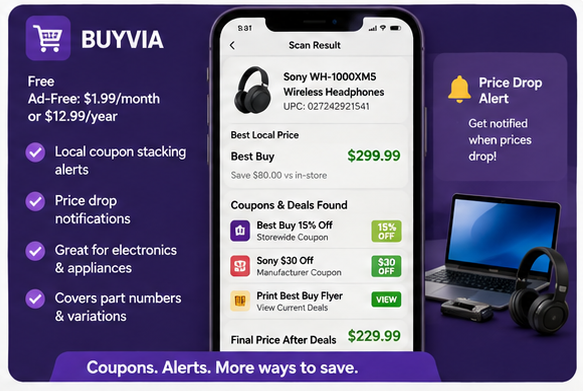
Pricing: Free / Ad-Free subscription options starting at $1.99/month or $12.99/year
BuyVia positions itself as both a local deal aggregator and a barcode scanner. While it handles everyday items well, our testing revealed that the app leans heavily into tech products, consumer appliances, and seasonal inventory, making it highly valuable for high-ticket electronics retail environments.
The Reality Check
The standout feature that delivers authentic value is BuyVia's localized coupon stacking alert engine. When we scanned a target item in-store, the app didn't stop at finding a cheaper base price nearby; it automatically cross-referenced the item against active manufacturer promotions, printable store flyers, and location-based digital coupons. If a neighboring retailer has a storewide 15% off coupon that applies to the scanned UPC, BuyVia surface-links it directly on the product overview screen.
Pros & Cons
* Pros: Excellent integration of local printable and digital coupons directly alongside UPC scan results; robust push-notification alerts for price drops on saved products; great coverage of part numbers and industrial product variations.
* Cons: The interface can feel overwhelming due to the sheer volume of daily deals pushing for attention; its price alert engine explicitly excludes tracking Amazon price changes.
For the casual shopper who strictly wants to scan an item and instantly see a checklist of alternatives without giving up their email address or sitting through a complex setup process, Price Check Scanner provides an incredibly fast, distraction-free experience.
However, for the definitive retail-hunting experience, ShopSavvy remains the absolute best app for local price comparison.
Even though navigating the ad-supported version can occasionally feel clunky, its superior machine-learning camera engine catches barcodes in dim or warped retail lighting where other apps stall. Most importantly, its ability to cleanly overlay localized pricing onto map thumbnails while serving up active retail price-matching rules makes it an indispensable tool for forcing big-box retailers to lower their prices right at the register.